Living rooms concentrate a broader assortment of domestic pollutants than almost any other space in a home. Between exterior particulates carried inside on footwear, pet dander accumulating on soft furnishings, seasonal pollen settling onto rugs, and chemical off-gassing released by synthetic upholstery, the ambient air in a family room demands rigorous filtration. Property owners looking to clean this air encounter two dominant technologies: High-Efficiency Particulate Air (HEPA) mechanical filters and activated carbon sorbent filters. These systems are frequently packaged together, yet they rely on opposing physical laws and address distinctly different contamination threats.
Choosing the correct setup requires identifying the exact contamination profile of your room. HEPA filters specialize entirely in halting microscopic solids, whereas activated carbon treats airborne gases and molecular vapors. Deploying a HEPA filter against tobacco smoke odor or solvent fumes will yield zero reduction in chemical concentration. Conversely, expecting an activated carbon block to catch fine dust or pollen will clog the sorbent bed and waste your equipment. Balancing these two media types depends on understanding their operating boundaries, physical properties, and airflow demands.
Core Differences in Filtration Media
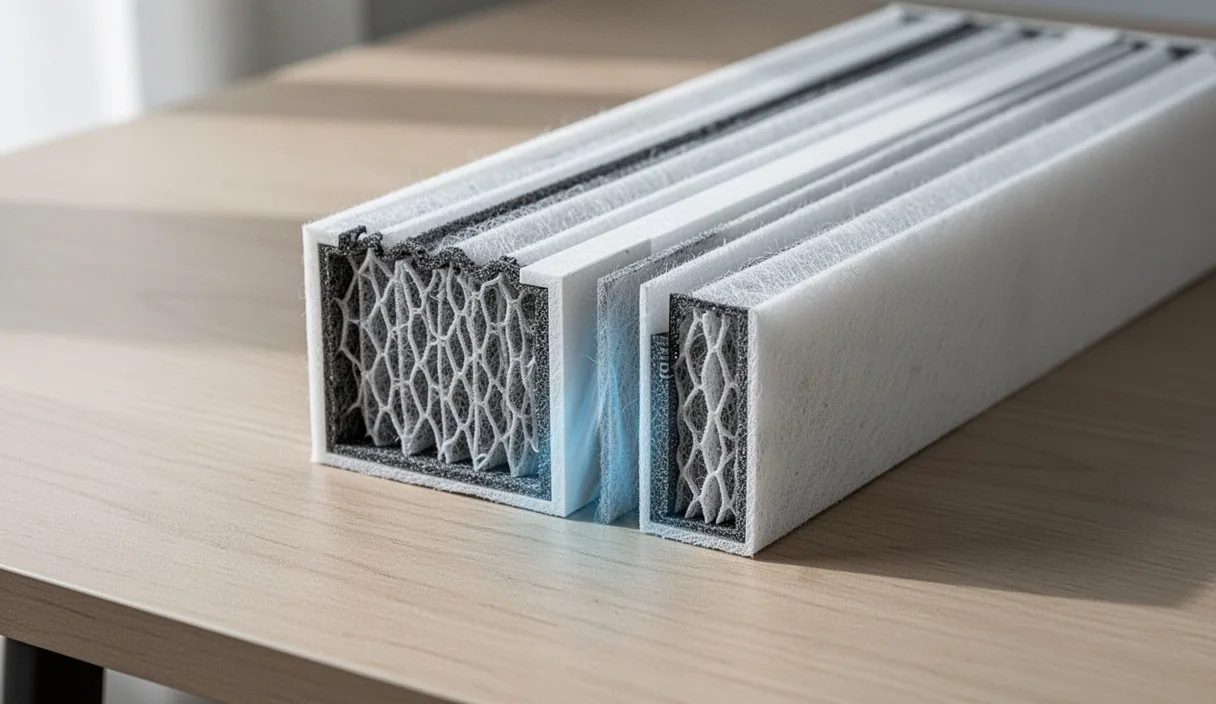
The operational divide between HEPA and carbon media stems from the difference between mechanical interception and chemical adsorption. A True HEPA filter consists of a dense, randomized web of borosilicate glass fibers or synthetic polymer filaments pleated across an exterior frame. As air passes through this tortuous path, solid particles collide with or adhere to the fibers. The filter functions entirely as a physical barrier designed to strip solids from the airstream without altering the chemical makeup of passing gases.
Activated carbon relies on surface chemistry rather than physical mesh netting. Manufacturers subject raw carbon sources, such as coconut shells, bituminous coal, or wood, to a thermal activation process using steam or carbon dioxide at temperatures exceeding 800 degrees Celsius. This treatment carves an intricate network of micropores, mesopores, and macropores throughout the internal matrix. A single gram of high-grade activated coconut-shell carbon features an internal surface area between 1,000 and 1,400 square meters. As gaseous molecules collide with this sprawling internal network, attractive van der Waals forces draw the molecules out of the air stream and lock them onto the carbon pore walls.
Because their mechanisms target separate phases of matter, neither medium can replicate the performance of the other. Mechanical fibers allow volatile chemical molecules to pass through without resistance because these molecules are thousands of times smaller than the gaps between the fibers. Similarly, activated carbon cannot process heavy particulate loads without suffering premature surface blinding, where coarse dust coats the intake face and prevents gaseous molecules from ever reaching the internal pore structure.
| Filtration Technology | Primary Target | Physical Mechanism | Ineffective Against |
|---|---|---|---|
| True HEPA | Microscopic solids (dust, dander, spores) | Impaction, interception, and diffusion | Cooking odors, VOCs, smoke gases |
| Activated Carbon | Gases, chemical vapors, and scents | Physical adsorption and pore trapping | Coarse dust, pollen grains, skin flakes |
| Carbon-Coated Sheet | Light, transient odors | Surface-level trace adsorption | Sustained chemical off-gassing, heavy smoke |
Particulate Capture Capabilities
Particulates inside a living area span a broad size spectrum. Coarse matter like coarse carpet lint and dog fur measures 10 micrometers or larger. Fine matter like atmospheric dust, mold spores, and dried pet saliva fragments falls between 2.5 and 10 micrometers. Ultrafine particles, including vehicle exhaust residue entering from open windows and soot particles from decorative candles, drop below 0.1 micrometers. True HEPA filters target this entire particulate spectrum through three simultaneous capture behaviors: inertial impaction, interception, and Brownian diffusion.
Large particles traveling at speed possess too much inertia to follow the curving airstream around the filter fibers; they crash directly into the glass strands and stick. Intermediate particles follow the airflow streamlines but brush close enough to the fiber boundaries to become caught by interception. Ultrafine particles smaller than 0.1 micrometers do not travel in straight paths. Instead, they bounce erratically off surrounding nitrogen and oxygen molecules in a pattern known as Brownian motion. This erratic zig-zag path substantially increases the likelihood that ultrafine soot and viral carriers will strike a fiber and remain trapped.
Under standardized United States Department of Energy testing, a certified HEPA filter must capture at least 99.97 percent of particles at the 0.3-micrometer diameter mark. This specific dimension represents the Most Penetrating Particle Size (MPPS), where impaction and interception become less dominant while Brownian diffusion is not yet fully effective. Above and below this 0.3-micrometer threshold, the retention rate climbs closer to near-total containment. Activated carbon contributes nothing to this mechanical capture rate. When operated without a HEPA stage, a carbon purifier allows dust, pollen, and pet allergens to circulate freely back into the living room.
Dealing with Household Odors and Volatile Compounds
Living rooms act as common reservoirs for volatile organic compounds (VOCs). These airborne chemicals evaporate at standard room temperatures from a variety of consumer goods. Common offenders include formaldehyde off-gassing from engineered hardwood adhesives, benzene from aged varnishes, and toluene from dry-cleaned textiles or household paints. Added to these are transient organic odors originating from adjacent kitchens, tobacco or cannabis smoke, and pet habitats. HEPA fibers offer no resistance to these compounds; molecular gases slip through the spaces between fibers like water through a fishing net.
Activated carbon is the primary consumer-grade defense against these compounds, but its effectiveness depends directly on the physical mass of the carbon bed. Many flat-panel purifiers sold for residential spaces contain nothing more than a thin foam sheet sprayed with carbon dust, often weighing less than 90 grams. Such token layers saturate within two to four weeks of standard use. Once every adsorption site fills, the sheet becomes inert and stops removing gases entirely.
True chemical mitigation requires a deep-bed carbon canister containing between 2 and 15 pounds of virgin granular carbon. The air requires adequate dwell time, the fraction of a second during which the air travels through the carbon bed, to allow gaseous molecules to contact the pore walls. For complex pollutants like formaldehyde, standard untreated carbon offers limited retention because the formaldehyde molecule is small and highly volatile. High-performance installations blend activated carbon with potassium permanganate or copper oxide. This addition causes chemisorption, a reaction that oxidizes toxic chemical vapors into inert carbon dioxide, water vapor, and mineral salts within the filter bed.
Calculating Clean Air Delivery Rates for Medium Rooms
Properly sizing an air purifier for a medium-sized living room prevents premature motor burnout and ensures genuine air cleaning. The Association of Home Appliance Manufacturers (AHAM) certifies purifiers using the Clean Air Delivery Rate (CADR). This metric measures the cubic feet per minute (CFM) of clean air delivered for three specific contaminants: tobacco smoke, dust, and pollen. A common benchmark for effective air cleaning is maintaining four complete Air Changes per Hour (ACH), though households with severe allergy sufferers or pets often aim for five.
To establish the required CADR for your room, follow a standard volumetric calculation rather than relying on manufacturer square-footage marketing claims, which frequently assume an inadequate two air changes per hour:
- Calculate Room Volume: Multiply the floor length by the floor width by the ceiling height in feet. For an average living room measuring 16 feet by 14 feet with 9-foot ceilings, the total interior volume is 2,016 cubic feet.
- Determine Hourly Demand: Multiply the volume by your target air exchange rate. To achieve four air changes per hour: 2,016 cubic feet multiplied by 4 equals 8,064 cubic feet of air that must be processed every sixty minutes.
- Convert to CFM Output: Divide the hourly demand by 60 minutes. In this example, 8,064 divided by 60 equals 134.4 CFM.
- Apply the Particulate Margin: Purifier blowers lose efficiency as filters collect debris. Add a 20 percent buffer to the baseline figure. A target of approximately 160 to 170 CFM on the AHAM smoke rating ensures the unit cleans the 224-square-foot room adequately even as the filter loads up.
HEPA and carbon filters impose different resistance levels on the motor. Thick HEPA media creates significant static pressure, requiring a strong, backward-curved fan blade to push air through the dense web. Dense carbon canisters present even higher airflow resistance. If your living room experiences both heavy pet dander and lingering chemical fumes, check that the unit provides independent CADR metrics for smoke and dust while running with both the HEPA element and the full carbon drum installed.
Filter Replacement Intervals and Signs of Wear
Operating a spent filter wastes electricity and can lead to secondary contamination. As particulate media clogs, airflow drops, putting mechanical strain on the fan motor. As carbon beds reach chemical saturation, they can begin desorbing, re-releasing previously trapped chemicals back into the living room as ambient humidity and room temperature fluctuate.
HEPA filters typically last between 9 and 14 months under standard domestic conditions. The clearest visual sign of HEPA degradation is dark gray discoloration across the intake pleats, caused by embedded soot, skin flakes, and combustion byproducts. However, color alone is not an absolute indicator; a discolored filter may still retain high collection efficiency while suffering reduced airflow. A more definitive metric is fan output. When the purifier produces noticeably weaker airflow on its highest speed setting, or the motor pitch changes due to backpressure, the pleats are choked and require replacement.
Carbon filters offer no visual indicators of wear. Because the internal pores fill at a molecular level, a saturated carbon canister looks identical to a brand new one. The service lifespan of carbon spans from 3 months for thin woven pads to 18 months for heavy granular canisters weighing over 5 pounds. The most reliable indication of carbon exhaustion is chemical breakthrough: persistent cooking smells, pet odors, or outdoor vehicle exhaust that linger in the room despite running the machine continuously. Some saturated carbon filters emit a distinct sour or vinegar-like scent when air blows through them, which signals that volatile acids have begun unseating from the pores and escaping back into the room.
Common Placement Mistakes Near Walls and Curtains
Even an appropriately sized HEPA and carbon purifier will underperform if placed in an airflow dead zone. In living rooms, owners often tuck purifiers behind armchairs, shove them directly against baseboards, or hide them behind long curtains to keep the hardware out of sight. Restricting the intake or exhaust reduces clean air delivery across the room.
When an air purifier sits flush against a wall, its intake grilles pull air from a restricted hemisphere rather than circulating air throughout the entire space. If the unit draws air from the back or sides, placing it closer than 18 inches to a drywall surface chokes the fan. This boundary creates local eddies where the machine repeatedly filters the same small pocket of air, leaving the center of the living room stagnant.
Curtains, drapery, and soft upholstery introduce three major mechanical hazards when placed near an air purifier:
- Intake Blockage: Lightweight fabric can get sucked against the inlet grilles, dropping fan intake to near zero and risking motor overheating.
- Air Deflection: Heavy velour or linen drapes positioned above or directly adjacent to the exhaust diffuser deflect the clean air jet downward or into the wall, breaking the macro-circulation loop of the room.
- Continuous Dust Shedding: Hanging textiles shed microscopic synthetic and cotton fibers continuously. A purifier running directly underneath curtains draws this heavy fiber load straight onto the pre-filter, consuming its capacity within weeks rather than months.
For optimal air circulation, position the purifier along the natural convection path of the room, ideally near an interior doorway, between major seating clusters, or near the primary source of pollutants, such as a pet bed. Maintain at least 15 to 24 inches of clear space around the entire perimeter of the machine.
Common Mistakes to Avoid
A frequent error is running an air purifier exclusively on its lowest or silent setting. While low settings minimize operational sound, they typically drop airflow output to 25 or 30 CFM, which is inadequate for a medium or large living room. At that output level, the unit cannot maintain four air changes per hour. Run the unit on medium speed for continuous cleaning, and reserve low mode primarily for overnight hours or quiet conversations.
Another widespread mistake is neglecting the washable pre-filter. The coarse screen located ahead of the HEPA and carbon stages exists to capture large pet hairs, lint, and insect debris. If this screen goes uncleaned for two or three months, it creates an airflow barrier that starves the downstream HEPA and carbon media. Inspect and vacuum this pre-filter every 30 days to protect your more expensive filter stages.
Homeowners also sometimes purchase ozone generators or unregulated ionizers under the impression that these devices clean air faster than mechanical filters. Ozone is a lung irritant that reacts with household materials to generate secondary pollutants like formaldehyde and ultrafine aerosols. Stick to mechanical HEPA capture and virgin activated carbon adsorption, which do not release chemical byproducts into your living space.
Practical Next Steps for Living Room Air Quality
To establish an effective filtration strategy for your shared living area, take these practical measures:
- Audit Your Primary Contaminants: If dust, pollen, and pet dander dominate your concerns, prioritize a unit with a certified True HEPA filter and high dust CADR. If wood smoke, cooking odors, or newly installed synthetic carpets are the primary issue, look for a model with at least 3 to 5 pounds of granular activated carbon.
- Measure the Floor Space: Calculate the room volume in cubic feet and ensure the smoke CADR rating achieves four air changes per hour based on your specific ceiling height.
- Clear the Operating Zone: Relocate the machine away from curtains, tight corners, and the backs of sofas. Maintain at least 18 inches of clearance from surrounding surfaces to encourage wide air mixing.
- Establish a Maintenance Cadence: Set a recurring reminder to inspect the pre-filter on the first day of every month, replace the HEPA core around the 12-month mark, and evaluate the carbon media for odor breakthrough every 6 to 9 months.
- Consult Professionals When Warranted: If you suspect toxic black mold behind baseboards, notice strong chemical odors after structural renovations, or experience persistent respiratory symptoms, arrange an inspection by a certified industrial hygienist or indoor environmental professional rather than relying solely on a consumer-grade air cleaner.