Indoor air quality is heavily dictated by unseen water vapor. Everyday household routines, such as taking hot showers, simmering stockpots, drying laundry indoors, and simple respiration, generate between 7 and 14 liters of moisture daily in an average four-person household. Without deliberate ventilation, this vapor accumulates within structural envelopes, settling into drywall, subfloors, and upholstered furnishings, creating an environment favorable to dust mites, bacterial proliferation, and surface fungi.
Managing this atmosphere requires balancing physical measurement, active mechanical extraction, and strategic passive ventilation. Guesswork often leaves occupants either over-drying their spaces, which causes mucosal irritation and warped wooden furniture, or running insufficient airflow cycles that let hidden mold colonies establish behind baseboards and exterior wall wardrobes. Mastering the triad of hygrometers, window trickle vents, and directional air currents offers a reliable, low-energy approach to keeping interior moisture within a safe, stable operational range.
Understanding Relative Humidity Indoors
Relative humidity, abbreviated as RH, measures the amount of water vapor present in the air expressed as a percentage of the total vapor the air could hold at that exact temperature. Warm air expands and holds significantly more moisture than cold air. When moisture-laden air cools down without losing any of its actual water mass, its relative humidity rises rapidly until it reaches dew point, the threshold where gaseous vapor condenses into liquid water droplets on cold surfaces.
For residential dwellings, the recommended baseline indoor relative humidity sits between 35% and 52%. Maintaining levels consistently below 30% dries out skin and nasal passages, accelerates electrostatic discharge, and shrinks structural timbers, causing floorboards to squeak and joints to open. Conversely, sustained readings above 58% create conditions where mold genera like Cladosporium and Penicillium can germinate on organic substrates within 48 hours.
A crucial factor to understand is microclimatic variation. A hygrometer sitting in the center of a living room might show a safe 46% RH at 21 degrees Celsius. However, behind a sofa placed flush against an uninsulated external wall, the air temperature might hover at 13 degrees Celsius. At that lower temperature, the local relative humidity can easily surge past 72%, inducing hidden condensation and mold growth without the main room display ever registering an alarm.
Placement Rules for Accurate Hygrometer Readings
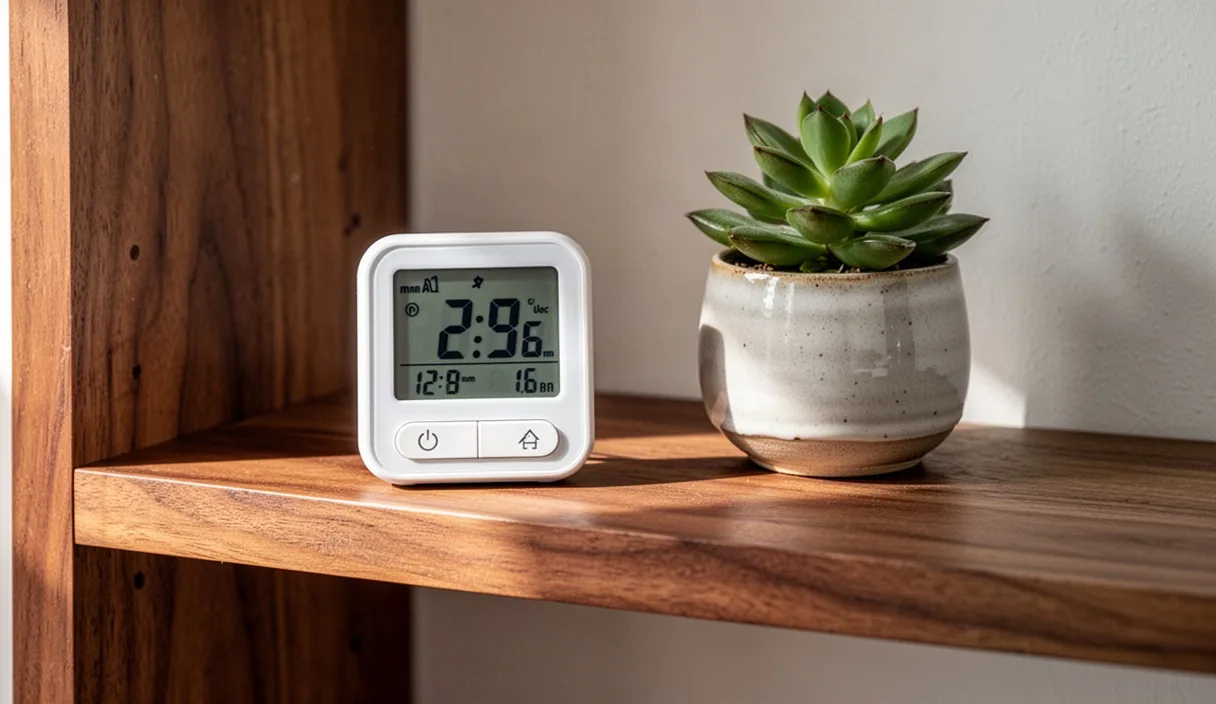
Digital consumer hygrometers typically use capacitive or resistive sensors to measure moisture levels. While modern sensors are generally reliable within a tolerance of plus or minus 3%, their readings become meaningless if the unit is installed in an unrepresentative microclimate. To obtain actionable data, hygrometers must reflect the breathing zone of the room rather than localized temperature anomalies.
Mount hygrometers on interior partition walls rather than external perimeter walls. Exterior walls conduct outdoor cold or heat, which alters the temperature of the sensor casing and produces false relative humidity readings. Position the device between 1.2 and 1.5 meters from the floor, which corresponds to seated or standing breathing height. Keep the sensor at least 1.8 meters away from heat sources like radiators, baseboard heaters, cooktops, and direct sunlight, as well as drafts from exterior doors and supply vents.
Testing Sensor Accuracy with a Salt Calibration
Low-cost consumer hygrometers often drift over time or leave the factory out of calibration. You can check sensor accuracy using a simple chemical property: a saturated sodium chloride (table salt) slurry produces a predictable 75.3% equilibrium relative humidity in a closed container at standard room temperature.
- Place one tablespoon of standard table salt into a shallow container, such as a plastic bottle cap.
- Add a few drops of water until the salt reaches the consistency of wet beach sand. There should be no standing water pooling on top.
- Carefully place the salt cap and the hygrometer inside an airtight, transparent container or a heavy-duty zip-top freezer bag.
- Seal the container tightly, leaving ample air space around the sensor vents of the hygrometer.
- Leave the sealed setup in an area with a stable temperature, away from drafts or direct sun, for 8 to 12 hours.
- Check the display through the container without opening it. A perfectly calibrated unit will read 75%. Note the discrepancy (for example, if it reads 71%, your sensor under-reports by 4%) and either adjust the onboard calibration screw or mentally apply the offset to future readings.
Seasonal Moisture Shifts in Living Areas
Managing indoor climate requires adjusting strategies between heating and cooling seasons. Cold winter air contains very little absolute moisture. When that cold outdoor air leaks inside and is heated to 20 degrees Celsius by a central furnace, its relative humidity plummets, often dipping below 25%. However, this low ambient reading masks the risk of localized condensation on thermal bridges, such as window headers, metal fasteners, and window corners, where indoor moisture migrates and hits cold building materials.
Summer presents the opposite operational problem. High outdoor temperatures allow ambient air to hold large volumes of moisture. When hot, humid air penetrates an air-conditioned interior, it meets cold supply registers, chilled floor tiles, and cool finished surfaces. If air conditioning equipment is oversized, it cools the home too quickly without running long enough to wring moisture from the air, creating a cold, clammy living space where relative humidity stays stuck above 62%.
| Season | Primary Moisture Hazard | Target Indoor RH | Recommended Action |
|---|---|---|---|
| Winter | Condensation on single-pane glass and exterior corners | 35% to 42% | Run spot extraction; keep window trickle vents open; warm up cold corners |
| Spring | Elevated ground moisture and damp crawl spaces | 42% to 50% | Transition from heating to mechanical ventilation; run basement dehumidification |
| Summer | Outdoor humidity infiltration and AC short-cycling | 45% to 54% | Run dedicated dehumidifiers; use low fan speeds on cooling equipment |
| Autumn | Trapped shower steam and indoor clothes-drying vapor | 40% to 48% | Engage cross-ventilation pulses; service mechanical exhaust motors |
Passive Airflow Techniques for Apartments
Apartment dwellers often lack the authority to cut holes through building envelopes for new mechanical ducts. In these properties, managing moisture relies on passive physics: natural pressure differentials, thermal buoyancy, and intentional pathway management. Passive ventilation replaces humid interior air with drier air without consuming electrical power.
Cross-ventilation operates on wind-induced pressure differences. The windward side of a building experiences positive pressure, pushing air into open windows, while the leeward side experiences negative pressure (suction), drawing interior air out. To clear a humid apartment rapidly after cooking or washing, open windows on opposing exterior facades simultaneously for 6 to 10 minutes. This short, intense burst, known as shock ventilation or Stoßlüften, exchanges the total volume of air without cooling down the dense thermal mass of walls and furniture.
In multi-level townhomes or apartments with high ceilings, the stack effect offers another passive tool. Warm, buoyant, moisture-laden air rises toward upper ceilings. By cracking an upper-level window or skylight slightly while opening a lower-level window on the cool, shaded side of the property, you establish a natural chimney effect that draws stale, moist air upward and out.
For daily background ventilation without wide-open sashes, maintain window trickle vents. These narrow horizontal slots built into the head of modern window frames provide between 2,500 and 5,000 square millimeters of equivalent free area. Leaving them open year-round creates a steady, draft-free background air exchange. Ensure that interior doors have a minimum clearance gap of 12 millimeters between the bottom of the door leaf and the floor finish, which prevents closed rooms from becoming pressurized, stagnant moisture pockets.
Selecting Between Dehumidifiers and Extractor Fans
While both appliances reduce indoor dampness, extractor fans and dehumidifiers serve distinct operational roles. Conflating their functions leads to wasted energy, premature equipment wear, or lingering moisture problems.
Extractor fans are source-capture devices designed to exhaust localized, highly concentrated moisture before it disperses across the dwelling. Building codes generally dictate that a bathroom exhaust fan must deliver at least 50 cubic feet per minute (CFM) of intermittent ventilation, or roughly 1 CFM per square foot of bathroom area for rooms under 100 square feet. A kitchen range hood should move between 150 and 300 CFM for standard domestic cooktops, venting outdoors through smooth-walled, rigid metal ductwork rather than recirculating through charcoal pads.
Dehumidifiers, on the other hand, are closed-loop moisture removal appliances for general living spaces, basements, and laundry storage areas. They do not vent air outside; instead, they draw ambient air across an internal coil or wheel, condense the water vapor into an internal reservoir or drain hose, and return warmed, drier air to the room.
| Feature | Centrifugal Extractor Fan | Compressor Dehumidifier | Desiccant Dehumidifier |
|---|---|---|---|
| Operating Mechanism | Mechanical air evacuation | Refrigerant cooling coils | Silica gel absorption rotor |
| Optimal Room Temp | Any functional temperature | Above 16 degrees Celsius | 1 to 20 degrees Celsius |
| Moisture Removal Rate | Immediate (cubic feet/min) | 14 to 35 liters per 24 hours | 6 to 12 liters per 24 hours |
| Installation Scope | Hardwired wall/ceiling ducting | Plug-in portable or ducted | Plug-in portable |
| Best Application | Bathrooms during/after showers | Heated living spaces, basements | Unheated garages, cold cellars |
Choose compressor-based dehumidifiers for finished, heated rooms where the ambient temperature consistently stays above 16 degrees Celsius. If you are dealing with unheated basements, crawlspaces, or utility rooms that drop below 12 degrees Celsius in winter, compressor coils will frost over, drastically reducing efficiency and triggering continuous defrost cycles. In those cold spaces, choose a desiccant unit, which extracts moisture effectively regardless of low ambient temperatures.
Maintenance Schedule for Moisture Control Equipment
Moisture control systems operate in damp, dusty environments, making them prone to particulate accumulation and biological fouling. Regular maintenance preserves design airflow rates and prevents appliances from re-introducing microbial contaminants into living areas.
Every Two to Three Weeks
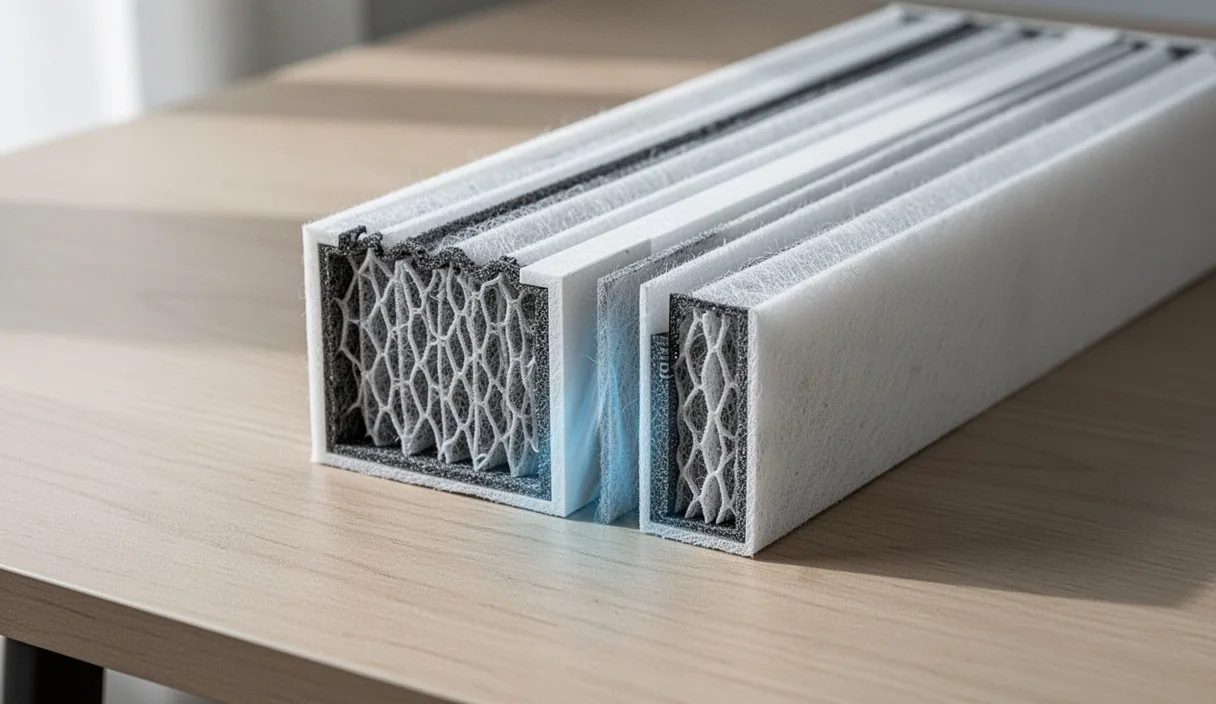
- Slide out the mesh intake filter on portable dehumidifiers. Wash it under warm water with a mild surfactant, rinse thoroughly, and let it dry completely before re-inserting it. A clogged filter starves the refrigeration coils of airflow, which drops system efficiency and can cause the compressor to overheat.
- Empty and inspect the dehumidifier collection bucket. Scrub the interior surfaces with a solution of 10% plain white vinegar and 90% water to break up the biofilm and slime that naturally forms in stagnant condensate water.
Quarterly
- Switch off electrical power to bathroom extractor fans at the distribution board. Remove the exterior plastic grille and vacuum accumulated lint, hair, and dust from the centrifugal impeller blades using a soft brush attachment. Dust accumulation on impeller blades can degrade fan airflow by more than 30%.
- Walk the exterior perimeter of the property to check external gravity flappers on exhaust terminations. Ensure the damper flaps swing freely on their hinges and are not blocked by spider webs, lint buildup, or debris.
Annually
- Perform the saturated salt test on all residential hygrometers to verify accuracy before the heating season begins.
- Inspect mechanical duct runs in attics or crawlspaces for sagging sections where condensed water can pool inside flexible ducting. Straighten any dips and confirm that all duct joints are sealed with foil-faced mechanical mastic tape rather than standard cloth duct tape.
Common Mistakes
The most pervasive mistake in home moisture management is shutting off bathroom extractor fans the moment the shower tap is turned off. Clearing the airborne vapor and drying the wet surfaces of tiles, mirrors, and enclosures requires running the fan for 15 to 25 minutes after bathing. Installing a push-button timer or a humidity-activated sensor switch ensures the fan operates for an adequate run-down cycle without requiring manual intervention.
Another frequent oversight is operating exhaust fans in airtight bathrooms without providing makeup air. If the bathroom door fits tightly against thick carpeting with no bottom undercut, the exhaust fan will pull against high static resistance, cavitating rather than moving its rated air volume. Leaving the door cracked open by two centimeters or ensuring a 12-millimeter gap under the door provides the makeup air needed for proper extraction.
Occupants also frequently position large, solid furniture items flush against cold, uninsulated external walls. Placing a dense wardrobe or headboard directly against an outside wall creates a stagnant, dead air pocket where interior heat cannot penetrate, while normal room humidity migrates inward. This drops the local temperature past the dew point, resulting in damp textiles and black mold colonies establishing unseen behind the backing boards.
Practical Next Steps
Begin by deploying two calibrated digital hygrometers: place one in the primary living space and another in the bedroom or bathroom zone that exhibits the most persistent moisture. Log morning and evening relative humidity readings alongside room temperatures for seven consecutive days to establish your home's baseline operational pattern.
Pull furniture at least 50 millimeters away from all external perimeter walls to encourage convective airflow along baseboards and finished surfaces. Inspect your window frames: if trickle vents are installed, slide them to the open position and clear their exterior mesh grilles of airborne debris.
If indoor relative humidity readings remain stubbornly above 60% despite proper exhaust fan usage and cross-ventilation, or if you discover water stains, musty odors, or persistent condensation along structural corners, consult a licensed HVAC contractor or a qualified structural surveyor. These symptoms often indicate concealed plumbing leaks, undersized mechanical systems, poor subfloor drainage, or broken building thermal envelopes that passive homeowner adjustments cannot resolve.